
New Guidance Improves Oral Health Awareness for People with Upper Limb Difference
A new patient-centred oral health resource, STOP TEETH, developed by Dr Claire Parkin and colleagues, is already making an impact in clinical practice, with prosthetists in Medway adopting the guidance and interest growing across the UK, Australia and the USA among rehabilitation professionals, amputee organisations, and dental associations.
The resource builds on research which found that 86% of adults with unilateral upper limb absence use their teeth during everyday activities, while 43% reported chipped or damaged teeth. Despite this, 97% had never received advice about the potential oral health risks associated with teeth use.
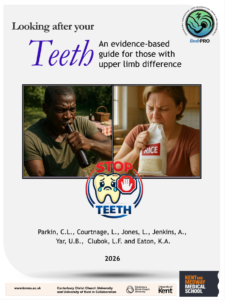
The findings prompted local prosthetists to reconsider their clinical practice, recognising how frequently patients rely on their teeth during functional tasks and highlighting the importance of discussing oral health as part of rehabilitation.
To address this gap, the team developed STOP TEETH, an evidence-informed, patient-facing guide co-produced by an international multidisciplinary team of clinicians, educators, and people with lived experience of upper limb absence. The resource aims to improve health literacy, encourage informed decision-making and support discussions about safer alternative strategies.
This work is an excellent example of research translating directly into practice, raising awareness of a previously overlooked issue and improving patient education and long-term health outcomes.
Read more:
- Research paper: https://pubmed.ncbi.nlm.nih.gov/42132283/
- STOP TEETH guidance: https://journals.kent.ac.uk/index.php/ajpp/article/view/1511/2584