
Most dentists can tell you what is wrong with UDAs. Far fewer have been asked what should replace them, and fewer still have had the chance to shape the answer before it arrives.
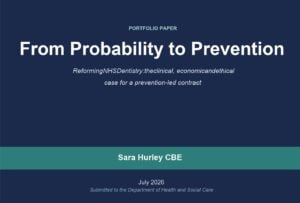
That was my starting point for From Probability to Prevention. After leaving the Chief Dental Officer role, one question stayed with me: what would an NHS dental contract look like if we designed it around the people who need care, their likelihood of disease and the teams delivering it? The paper that has emerged from those reflections is my attempt at an answer. It is independent, unfunded and deliberately specific, and I have shared it with the Chief Dental Officer for England and the DHSC ahead of the promised consultation, which we are still waiting for.
On Monday 16 November, the LDC Confederation Board put it to the test. Over 90 minutes, colleagues brought the proposal firmly down to earth: practice finances, associates’ pay, patients who don’t attend, and whether we risked swapping one form-filling exercise for another. A fuller Q&A, with each question and my response, is linked below. These are the threads that mattered most.
Starting with access
Access is the reason for change. Between 2017 and 2026, England lost around 600 practices holding a general NHS dental contract, roughly one in ten (Nuffield Trust, 2026). Raising the minimum UDA value to £28 did not increase delivery in the contracts it targeted, and asking a shrinking network to do more activity will not close the access gap.
The GDS system is built around the individual: payment follows each course of treatment. The proposal describes a system built around the population and the provider. Practices would receive an annual, need-adjusted payment for each registered patient, with separate funding for prevention delivered, laboratory work, urgent care and quality. Disease risk and local delivery costs are adjusted for separately, so rural, coastal and inner-city practices are not forced into the same mould. The formula allocates resources; it does not limit or decide an individual patient’s care. Clinical assessment does that.
Registration drew some of the sharpest questions. It would be formal, consented and conditions-based, continuing while patient and practice each meet their responsibilities, including risk-based recall, rather than lapsing after a fixed period. It would not mean every treatment is available on the NHS, and patients could still pay privately for discretionary care such as cosmetic treatment, so the NHS boundary must be clearly defined and clearly explained.
Prevention becomes funded work rather than a closing remark at the end of an examination. And a named dental home gives the rest of the NHS someone to work with: connecting periodontal care with diabetes management, or getting patients dentally fit before cancer
treatment, major surgery or a general anaesthetic. That matters to ICBs and hospitals managing outcomes and waiting lists.
The business of dentistry
Much of the session focused, rightly, on business models. Associates came first. The NHS has never prescribed how dental practices employ or pay their clinicians, and this proposal would not change that. But a contract built on registration and prevention would loosen the link between UDA delivery and pay, so practices would need new arrangements: salaried, sessional or blended. The same applies to therapists, hygienists and dental nurses, on whom a prevention-led model would depend.
General practice was the obvious comparison, with weighted capitation, salaried and sessional GPs, and a genuinely multidisciplinary team. There are lessons in its strengths, and in the strain on the partnership model.
The John Lewis Partnership was offered as another way of thinking about ownership, particularly for new practices in dental deserts, where a stake in the business could help recruit and keep a team.
I also raised, in passing, growing investor interest in NHS dentistry. Sector advisers see contract reform as a key driver of that appetite. However, public funding for a registered population is not an ordinary commercial asset, and the contract should be neutral about ownership and clear about responsibilities.
Nor is NHS or private a binary choice. Mixed practices are vital for patient choice and integral to the future of publicly funded care. In dental deserts, new providers may find a predominantly NHS practice is not just the optimal model but the most viable one. Whether the model works for any individual practice is a question for practice-level modelling, not national averages.
Keeping it simple, and paying for it
One Board member asked the question every reform should face: are we making this too complicated? The paper is detailed because it has to be; the contract doesn’t have to be complex or complicated. The current arrangements, by contrast, are both, with layers of regulations, financial directions, policy book and guidance for practices to navigate. Software, not practice managers, should do the arithmetic.
On cost, the central model projects around 9.8 million more patients gaining access, at a net new investment of about £97 for each. The modelling is my own and needs professional testing, but the principles are sound, and practices would need funding up front rather than the promise of savings elsewhere.
Transition should be practical. Where GDS arrangements are working, they can continue; where NHS provision has collapsed, the population oral health model may be the better fit.
We don’t need one size to fit all. We need a fairer system for all.
Over to the profession
The Government has committed to fundamental contract reform by the end of this Parliament. Too often, the profession is consulted once the important decisions have been taken. This time we can help build the alternative, rather than wait to comment on someone else’s.
The LDC network understands the practical limits of UDAs better than anyone. That experience is exactly what the next contract needs. Read the full Q&A from the Board discussion https://ldc.org.uk/from-probability-to-prevention-questions-from-the-ldc-confederation-board/
Former Chief Dental Officer (England)